Culture Tax
Payroll is one of the biggest expenses in most organizations. Executives know it. Finance teams know it. HR knows it. Every company on Earth is trying to optimize labor costs in some way.
And yet companies still act shocked when unhappy employees become expensive. Like it’s a mystery.
Meanwhile communication slows down, mistakes increase, trust disappears. People quietly start job hunting during lunch breaks and entire departments begin emotionally unraveling.
That’s not random. That’s culture.
Most organizations are paying what I call the culture tax — a hidden operational cost created by bad culture. Once you see it, you can’t really unsee it.
The problem is that culture is still treated as branding instead of infrastructure. Corporate culture often exists as mission statements, leadership slogans, onboarding presentations, engagement campaigns, and framed company values hanging beside broken vending machines.
Most employees hear more about company culture during orientation than at any other point in their employment. That’s when organizations perform culture most aggressively.
But culture is not what a company says during onboarding. Culture is what employees observe after pressure arrives. Employees watch how leadership behaves under stress, who gets protected, who gets ignored, whether accountability is consistent, whether honesty feels safe, whether burnout is normalized, and whether people are treated like humans or outputs.
That lived experience becomes the real culture. A company can spend hours talking about integrity during orientation, but employees will learn far more from watching how leadership handles one difficult situation.
The real orientation starts after HR leaves the room.
One of the most important things I’ve learned is that every workplace has two cultures: the official culture and the underground culture.
The official culture lives in websites, executive speeches, LinkedIn posts, branding, and values statements.
The underground culture is the shared truth employees experience over time. It lives in breakrooms, side conversations, group chats, dark humor, whispered warnings to new hires, “off the record” conversations, and the look coworkers give each other after a strange meeting.
That’s where employees collectively figure out what behavior actually gets rewarded, who can be trusted, whether leadership is honest, whether accountability is real, and whether emotional safety exists.
Employees trust experienced culture far more than branded culture.
I’ve worked in environments where employees could have made more money elsewhere. And they stayed anyway. Not because of the corporation. Not because of the mission statement. Not because of Employee Appreciation Week. They stayed because of each other — because trust existed, because the environment felt survivable, because coworkers protected each other emotionally during difficult seasons.
People do not stay loyal to slogans. They stay loyal to ecosystems that make hard work bearable.
And when organizations forget that, they start optimizing for numbers while destabilizing the very people keeping the system running.
I once had six employees converted to full-time by a client in the same week. From the outside that should have looked like success. Six people became stable. Six placements worked. But instead of celebration, leadership focused on the hours we would lose and the drop in gross profit. I remember asking my boss: “Am I doing too good of a job?”
Employees notice those contradictions immediately. That’s how underground culture forms — not through one dramatic event, but through repeated moments where you see the company says one thing and does another.
At the same time, I’ve watched companies slowly poison their own culture through passive leadership, inconsistent accountability, metric obsession, and emotional detachment.
The effects show up long before leadership admits it. People disengage. Morale shifts. Employees emotionally withdraw. Then leadership looks around and asks, “Why is productivity down?” As if productivity exists separately from human emotion.
But human beings are not machines. Trust affects efficiency. Psychological safety affects collaboration. Fear affects communication. Burnout affects performance. Emotional systems are operational systems.
Companies get this when money is on the line. They invest heavily in customer experience because they know frustration changes behavior. But many still treat employee emotion like an HR side issue instead of an operational condition — even though employees are the ones carrying the whole operation.
An employee who feels respected, informed, stable, and psychologically safe will almost always outperform an employee operating in survival mode. Not because they are morally superior. Because human beings function better when they feel safe.
And this is where culture becomes either an efficiency multiplier or an efficiency tax.
Good culture creates resilience. Bad culture creates drag.
The drag rarely arrives as one dramatic invoice. It arrives in reduced effort, emotional detachment, distrust, low initiative, burnout, coworkers mentally checking out before they physically leave, and the quiet understanding that caring too much no longer feels safe.
Companies spend millions trying to optimize productivity while ignoring the emotional infrastructure that determines whether people can actually function well together.
That may be one of the most expensive business mistakes modern organizations continue to make.
Culture is not a soft metric. It is operational infrastructure.
Every organization pays for culture eventually. The only question is whether they pay through intention or deterioration.
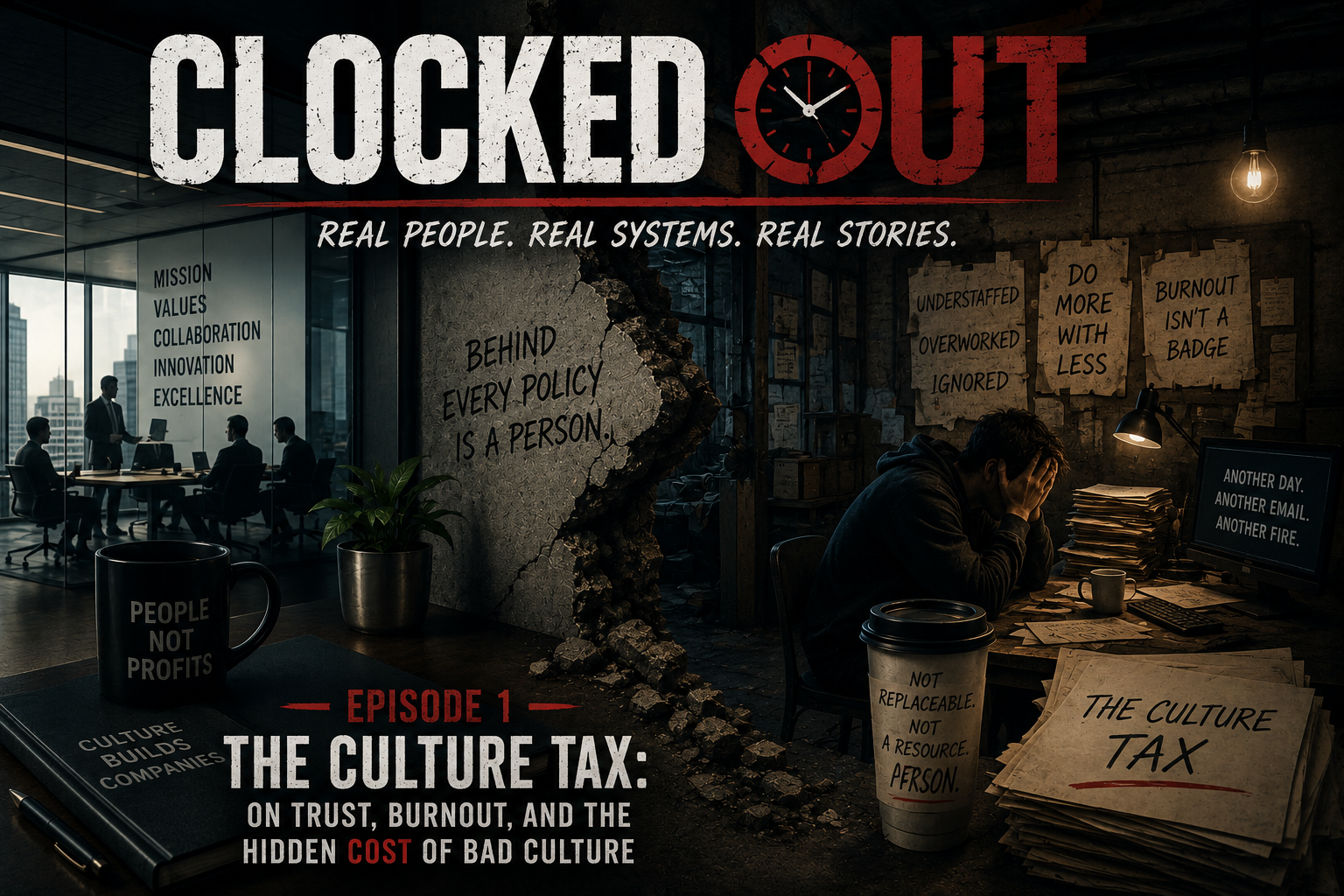
If this essay resonated with you — if you’ve ever worked somewhere that slowly changed the way people communicated, trusted, or survived together — I explore these ideas more deeply on my podcast, Clocked Out.
Clocked Out is a series about workplace culture, burnout, leadership, emotional systems, labor, hiring, organizational behavior, and the hidden realities employees experience behind corporate language and performance metrics.
Future essays and episodes will continue exploring the gap between official culture and experienced culture — and what happens to people inside that gap.
Follow along for future episodes, essays, and conversations.